Is luck real? Ask a successful entrepreneur, and they'll tell you they made their own luck. Ask someone who lost their lottery ticket, and they'll swear the universe conspired against them. The truth, as it turns out, is far more nuanced than simple fortune or misfortune. It lies in the intersection of probability, psychology, and how we interpret the randomness around us.
The Philosophical Divide: Superstition vs. Probability
For centuries, luck occupied an uncomfortable space between science and superstition. Ancient civilizations attributed chance events to the whims of gods and fate. Today, we understand that probability governs many outcomes—yet the word "luck" persists in our vocabulary, suggesting something beyond pure mathematics.
Modern philosophy distinguishes between two interpretations: luck as mere superstition (believing a black cat brings misfortune) and luck as the legitimate but unpredictable outcome of probabilistic events (drawing a certain card from a shuffled deck). The second interpretation is what makes luck philosophically interesting. It acknowledges that some outcomes depend on factors beyond our control, and some depend on factors we cannot predict, despite understanding the underlying probabilities.
The key insight: luck isn't magical—it's the name we give to unpredictability.
Moral Luck: When Your Outcomes Depend on Things You Didn't Control
Philosopher Thomas Nagel introduced the concept of moral luck—the idea that how we're judged (morally, professionally, personally) often depends on circumstances entirely outside our control. There are several types:
Situational luck means the environment you're born into, the mentors you happen to meet, the economy when you start your career. A brilliant entrepreneur born in a poor country faces different odds than an equally talented peer in a wealthy one. Neither earned those odds—that's luck.
Constitutional luck refers to your natural talents, intelligence, health, and disposition. You didn't choose your brain, your work ethic, or your genetic resilience. Yet these factors, combined with circumstances, largely determine your life outcomes. This recognition is humbling: much of what we attribute to personal merit is actually luck in disguise.
The Psychology of Luck: Why "Lucky" People Just See Better
Psychologist Richard Wiseman's groundbreaking research turned our understanding of luck inside out. In one famous study, he asked "lucky" and "unlucky" people to count photographs in a newspaper. He planted a large message halfway through: "Stop counting. There are 43 photographs in this newspaper." Lucky people noticed immediately; unlucky people missed it entirely.
The revelation: luck isn't destiny—it's a pattern of noticing opportunities. Wiseman found that lucky people share common traits: they're more relaxed, more open to new experiences, and crucially, more attentive to unexpected possibilities. When you're tense and focused narrowly on one goal, you miss the lucky breaks happening around you. When you're open and relaxed, you spot opportunities others overlook.
This reframes luck entirely. A "lucky" person isn't blessed by fate; they're simply better at the cognitive task of seeing and seizing unexpected advantages.
The Illusion: Confirmation Bias and Lucky Streaks
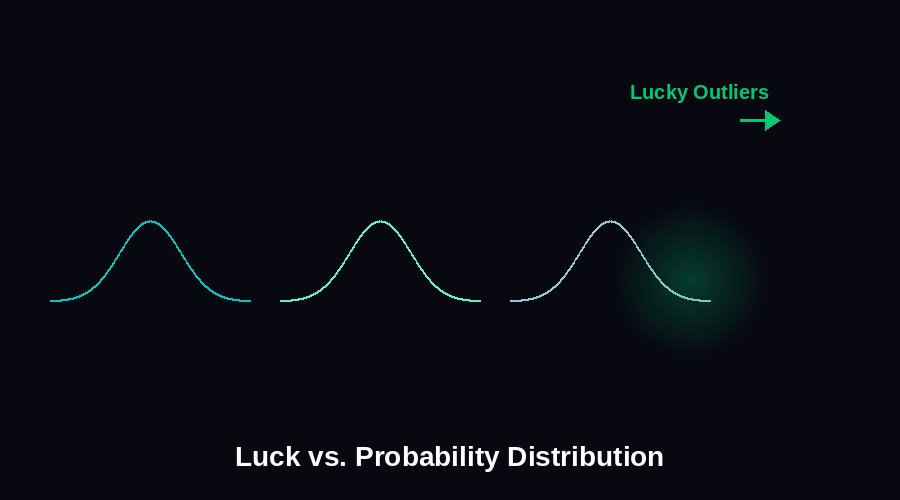
Our brains are pattern-recognition machines, which makes us prone to seeing luck where there's only randomness. This is confirmation bias in action: when you believe you're lucky, you notice and remember the times luck appears to favor you, while forgetting the times it doesn't.
Flip a coin 100 times, and you'll find sequences of 6 or 7 heads in a row—not because the coin is on a "streak," but because randomness produces streaks naturally. Yet when we're in the middle of that streak, we feel lucky. When it ends, we feel unlucky. The streak was always inevitable; we simply notice them when we're emotionally invested.
"A lucky streak is just the law of large numbers playing out in real time, with your hopes and fears as the narrator." — David Hume
Understanding this is liberating. Many "lucky streaks" are just statistical inevitabilities. The real opportunity lies in what you do while the streak lasts—and whether you're prepared to capitalize on luck when it arrives.
Luck vs. Skill: Disentangling Randomness and Ability
Perhaps the most important question is this: how much of success is luck versus skill? The answer depends entirely on the domain.
In sports, a basketball player's free-throw percentage is skill (repeatable under controlled conditions). But whether they win the championship also depends on injuries, referee calls, and bounce-of-the-ball luck. A batter with a .300 batting average is skillful, but whether they hit a home run in a crucial moment involves randomness.
In business and investing, the waters are murkier. Some successful investors attribute their returns to stock-picking skill, yet studies show that over long periods, most underperform index funds. Were their past successes skill or luck? Likely both—and separating them is nearly impossible without decades of data.
The uncomfortable truth: in any field where randomness plays a role, distinguishing luck from skill requires far more data than we typically have. A CEO who quadrupled company value might be a genius, or might have simply been lucky enough to lead during a boom market. Only time reveals which.
You Can't Control Luck—But You Can Control Your Exposure to It
Here's what we actually know about controlling luck: directly, you can't. You can't will the die to land on six or force the interview panel to like you. But you can control three things:
First, you can increase your exposure to chance. Entrepreneurs who try many ventures are more likely to hit a massive success than those who try one. Job hunters who apply to 50 positions are more likely to land a great role than those who apply to five. Luck is a numbers game—more attempts means more opportunities for luck to strike.
Second, you can train yourself to recognize opportunities. Wiseman's research shows this is learnable. Relax. Stay curious. Notice small things. These habits rewire how you perceive randomness, turning luck from something that happens to you into something you're prepared to seize.
Third, you can improve the skill components of what you do. While randomness affects outcomes, skill reduces its impact. A better chess player beats a worse one despite some luck in the position. A more disciplined saver accumulates wealth despite market volatility. Skill doesn't eliminate luck—it gives luck less room to wreak havoc.
The Real Lesson About Luck
Luck is real, but not in the way we usually imagine. It's not magical intervention or cosmic fairness. It's the recognition that some outcomes depend on factors outside our control—and that our job is to prepare ourselves to recognize and act on the opportunities that randomness creates.
The luckiest people aren't those blessed by fate. They're those who understand probability, remain open to unexpected possibilities, and put themselves in positions where luck can find them. They've stopped waiting for luck to strike and started building the conditions where they'll recognize it when it does.
Sometimes the luckiest thing you can do is remove your own bias from the equation. Let the wheel decide.