The Coin Flip Experiment That Reveals Our Bias
Here's a simple test: grab a piece of paper and write down 100 coin flips without actually flipping a coin. Just use your imagination. When researchers have done this experiment hundreds of times, they've discovered something fascinating: humans almost never produce truly random sequences.
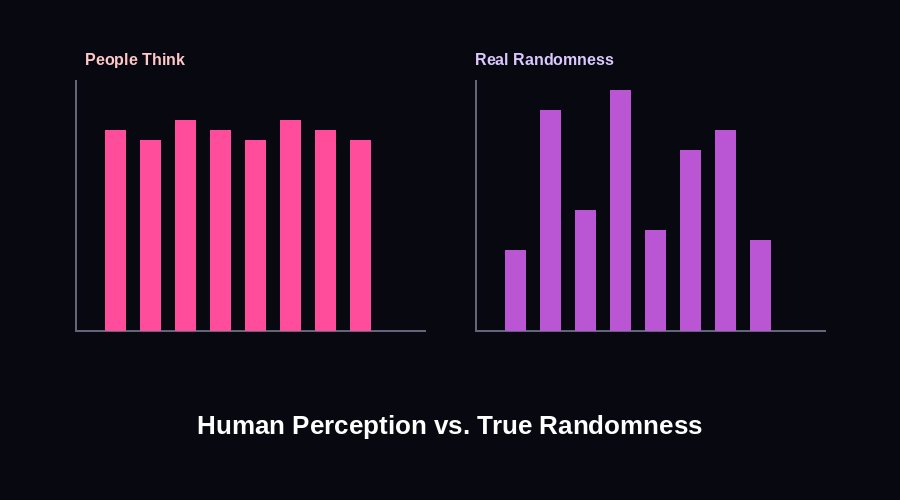
The most common mistake? We avoid long streaks. Real randomness, paradoxically, produces more runs of identical outcomes than our brains consider acceptable. When we flip a fair coin 100 times, we expect to see sequences like HHHH or TTTTTT scattered throughout. But when asked to imagine randomness, people almost never write more than two or three identical outcomes in a row. Our brains instinctively "correct" what feels too clustered, systematically eliminating the very patterns that define true randomness.
The Cognitive Biases That Sabotage Randomness
Three powerful cognitive biases work together to make us terrible at randomness. The availability heuristic means we overweight recent or vivid examples—if we just flipped five heads in a row, we "feel" like heads is more likely, even though it isn't. The alternation bias makes us compulsively switch between options, convinced that alternation equals randomness. And the recency bias causes us to think the last few outcomes somehow predict the next one.
These biases exist for good reasons. They help us spot real patterns in a world full of genuine causation. But when true randomness is the goal, these mental shortcuts become mental roadblocks. Your brain evolved to find patterns, not to generate noise.
The Hot Hand Fallacy and Streaks in Skill
Things get even more interesting when skills are involved. The "hot hand fallacy" is the belief that when someone is on a winning streak—especially in sports—they're in a special state of heightened ability. A basketball player who makes five shots in a row must be "hot," right? Intuitively, it feels true.
But research by Gilovich, Vallone, and Tversky in the 1980s revealed the uncomfortable truth:
most apparent "hot streaks" are just what randomness looks like. A skilled player making shots at, say, 50% will naturally have stretches where they make six or seven in a row simply by chance.When we see these streaks, our pattern-detection brains scream that something special is happening—but the data disagrees. The illusion persists because we're excellent at noticing streaks and terrible at understanding randomness.
When Shuffle Felt Too Random
Apple learned this lesson the hard way with the original iPod shuffle. When engineers designed the shuffle algorithm to be truly random, users hated it. They complained constantly: "It keeps playing songs by the same artist!" or "Why does this song keep coming up?" The algorithm was working perfectly—it was just that perfect randomness feels wrong to human ears.
In response, Apple implemented a deliberately non-random "shuffle" algorithm that avoided clustering similar artists and songs. They had to make randomness less random to make it feel random to users. This counterintuitive decision reveals a fundamental truth: our intuitions about randomness are backwards.
The Password and Lottery Problem
The consequences of our randomness blindness extend far beyond coin flips and shuffle algorithms. When people choose "random" passwords or PINs, they create predictable patterns that hackers exploit mercilessly. Security researchers have found that approximately 35% of people choose "1234" as their PIN—not because it's truly random, but because our brains default to simple sequences. When lottery players pick "random" numbers, roughly 29% use birthdates, clustering their choices into the range 1-31. Winners often discover they must split their jackpot with dozens of others who picked the same "random" numbers.
Security Implications: Your "Random" Password Isn't
This predictability has serious security consequences. Hackers know that human-chosen "random" passwords cluster around keyboard patterns, dictionary words, and personal dates. When you try to be random, you're likely choosing from a much smaller effective space than you think. A password that feels random to you might be guessable in seconds to someone who understands human bias patterns.
The fix? Stop trying to be random. Use password generators, cryptographic random number systems, and tools designed specifically to inject true randomness into your choices. Your brain is extraordinary at many things—pattern recognition, creative thinking, understanding nuance. Generating randomness isn't one of them.
The Takeaway: Let Algorithms Win at Their Game
The lesson is clear: humans are terrible at being random because our brains evolved to detect patterns, not generate them. Trying to force yourself to think randomly is like trying to think in quantum mechanics—it goes against cognitive instincts honed by millions of years of evolution. The solution isn't to try harder. It's to step aside and let algorithms do what they do best. For passwords, lotteries, sampling, security, and any situation where true randomness matters, defer to the tools built specifically for this purpose. Your brain will thank you, and your security will improve dramatically.